What Do You Need To Study To Become An Architect?



Quick Links
If you are interested in a career that blends engineering with creativity, then architecture might be for you. As an architect, you’ll design residential and commercial buildings and other functional yet appealing structures.
This career path has a promising outlook. According to the United States Bureau of Labor Statistics, the number of architecture jobs will grow by 8% between 2023 and 2033 — which is faster than average.
If you’re ready to start your journey, the first step is knowing what to study to become an architect.
To become an architect, you must complete a relevant degree. Let’s discuss what you have to study to become an architect.
Whether you have just finished high school or are considering a career change, an associate degree is a good place to start. This is especially true if you want to save money before transferring to a bachelor’s program. An Engineering Physics Degree is one option.
While “architecture” isn’t in the degree’s name, the science, technology, engineering and mathematics (STEM) knowledge you’ll gain contributes to a successful architecture career. And at Mount Wachusett Community College (MWCC), you’ll gain valuable hands-on training and experience.
We also have transfer agreements with private and public four-year schools, including Northeastern University and Fitchburg State University, so you can complete your bachelor’s degree after earning your associate degree. We designed our program based on STEM core requirements — so transferring your credits to another higher education institution is easier.
To begin an architecture career, you will need to complete a five-year Bachelor of Architecture (BArch). A BArch degree involves a mix of classroom and studio experience that will help you understand architecture fundamentals. Depending on where you study, BArch programs can include classes related to:
For many states, a BArch degree must be accredited by the National Architectural Accrediting Board (NAAB). If you want to know about your state’s requirements, the National Council of Architectural Registration Boards (NCARB) provides information on state licensing requirements for architects.
If it aligns with your career goals, you can also complete a Master of Architecture (MArch). A Master of Architecture program is typically best for students who want to specialize in a particular area or whose undergraduate architecture program is not accredited by the NAAB. However, these individuals can also earn their initial license in one of the 17 jurisdictions that offer pathways for applicants who do not hold a degree from a NAAB-accredited program.
There are a few undergraduate programs you can explore to become an architect, depending on your passions and goals.
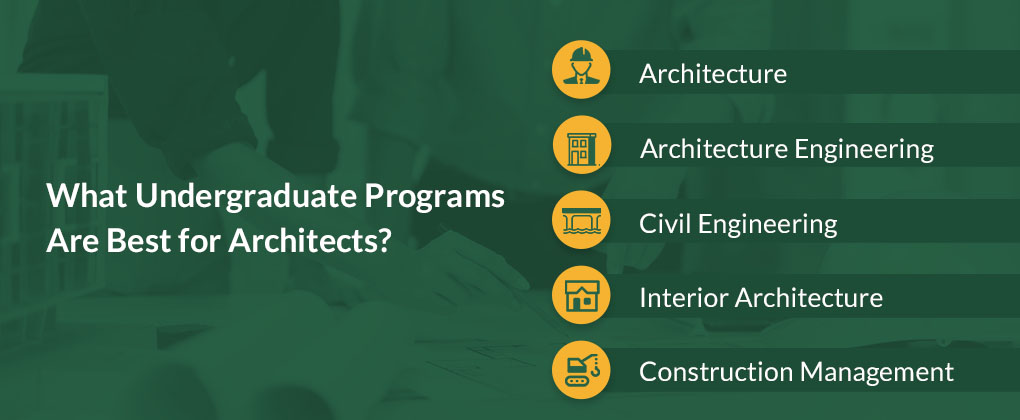
An architecture program, particularly a BArch, is a straightforward path. A BArch focuses on theory and design and the historical and technical aspects of buildings and spaces. If you want to become a licensed architect, this is the most direct route, and it often requires an internship to complete licensure requirements.
This program blends architecture with engineering. You’ll typically focus on the technical side, learning how buildings are designed to be structurally sound and sustainable. It’s ideal if you want to be involved in the technical and mechanical systems of buildings while working closely with architects.
Civil engineering is broader than architecture. This program focuses on the design and construction of infrastructure like roads, bridges and even water systems. If you’re interested in the structural, transportation and environmental side of architecture — or large-scale projects — this could be a good fit. However, it’s more engineering-focused than architecture-focused.
If you’re more passionate about interior design and creating functional yet aesthetically pleasing spaces, this program may be for you. Interior architecture generally focuses on the design of interior environments, often with an emphasis on architecture. It’s a great option if you’re interested in the human experience within built spaces and want to work on residential and commercial interiors.
This program focuses on the management side of building projects, from budgeting and scheduling to delegating and overseeing construction processes. While it’s not design-orientated like architecture, it’s perfect if you want to work on the project management side of the profession.
Yes, to become an architect in the U.S., you will need a license. More specifically, you must pass the Architect Registration Examination (ARE) offered by the NCARB. The ARE is a multipart exam that tests your architecture knowledge and skills in various divisions.
However, you must first be eligible to take this exam. Graduates who earned a BArch degree from a NAAB-accredited institution must complete a lengthy period of paid internship experience. Most graduates can complete their training by working at an architecture company through the Architectural Experience Program (AXP) — previously known as the Internship Development Program (IDP).
The NCARB also offers the Integrated Path to Architectural Licensure (IPAL). This accelerated pathway option allows you to complete your ARE experience and exam requirements while earning your BArch degree. Ensure you meet the additional jurisdictional requirements according to your state.
Once you’ve completed the ARE, you can apply for your state’s architecture license.
Whether you recently received your license or have been a practicing architect for years, you can pursue the NCARB Certificate. This certificate may not be required, but it can add value to your resume and help you stand out from the crowd. There are numerous benefits of having an NCARB certificate, including gaining access to free continuing education courses.
Although the requirements may vary, many states require you to complete some form of continuing education (CE) to keep your license active. You can use NCARB’s licensing requirement tool to see your state’s requirements. With the NCARB certificate, you gain free access to NCARB’s continuing education courses — which cost $25 each for non-certificate holders. You can find other CE opportunities through relevant workshops, conferences, courses and university classes.
A few electives and supplemental subjects can prepare you for a successful architecture career. These subjects include:

Now that you know what to do to become an architect, you can start your journey at The Mount. MWCC’s Engineering Physics Associate Degree offers a quality education at an affordable price. Our program is designed to develop your analytical skills to support a successful career in architecture or any other engineering and physics profession.
After graduating, you can transfer to a four-year institution to further your education — helping you save time and money in the long run. Apply at MWCC now to take the first step toward a rewarding career, or request more information about our programs.

Your journey starts with a single step. We have all the information you need to move forward with confidence. Reach out today to learn more about life at The Mount and how to get started.
