What To Study To Become A Teacher



As of 2025, Massachusetts has the third-highest average teaching salary in the nation. Of course, teaching is more than just a career for some. Whether you’re curious or answering a calling, it’s worth fully understanding what you need to study to become a teacher.
Your journey toward becoming a licensed teacher will include a combination of completing education and training programs, earning degrees, passing exams, gaining classroom experience and fulfilling state requirements. For many, the first step is building a strong foundation at a community college.
To become a licensed teacher in Massachusetts, you’ll typically need a bachelor’s degree. The journey often begins with an associate degree at a community college to explore subjects and build skills before university.
While some Early Childhood Education teaching positions may be accessible with an associate degree alone, an associate degree for aspiring teachers usually aims to prepare them to transfer into a bachelor’s program. The many benefits of earning an associate degree at a community college include:
In Massachusetts, as in most states in the United States, a bachelor’s degree or higher is typically required to become a licensed teacher. While there are some alternative routes, transferring credits from your associate degree into a four-year bachelor’s program is a well-established pathway to becoming a teacher.
Many community colleges have transfer agreements with public and private four-year schools, allowing students to transfer seamlessly and complete their bachelor’s degrees. The Mount has transfer agreements with Fitchburg State University, MCLA, Salem State University, Westfield State University, UMass Boston, Rivier University, and Southern New Hampshire University that allow students to develop complete, valuable groundwork in community college before transferring to a university.
While any major is acceptable for elementary education, an aspiring secondary education teacher must have a degree or significant coursework in the subject they plan to teach. For example, a biology teacher must have completed a biology major or a large amount of coursework in the subject.
While some students go straight from school to get a bachelor’s degree, many find a strategic advantage in starting their higher education journey at a community college. Beginning higher education in a community college can give aspiring teachers the chance to explore their options, build a solid base and save money before committing to a four-year program. By carefully selecting an associate degree, you can set yourself up for success in your future teaching career.
When it comes to what you have to study to become a teacher, there are many exciting options that you can choose from based on your interests. Aspiring teachers can choose from standard associate degree options, such as:
While these broader options are perfectly suitable, community college students may also have the choice to specialise in associate degrees focused on education. For example, MWCC offers education-centric degrees and certificates focused on Early Childhood Education, Elementary Education and Secondary Education. The Mount has a Secondary Education Degree Pathway agreement with Fitchburg State, with the following programs included:
While these more degrees include multiple subjects, they allow prospective teachers who know which subject they want to focus on to develop skills in their desired field before enrolling in a bachelor’s program.
Your degree coursework will provide essential pedagogical knowledge. Supplementing your studies with courses like psychology and philosophy, and with practical experiences like tutoring, can build your knowledge and skills. These areas offer unique perspectives and practical experience to enrich your understanding of students and the learning process.
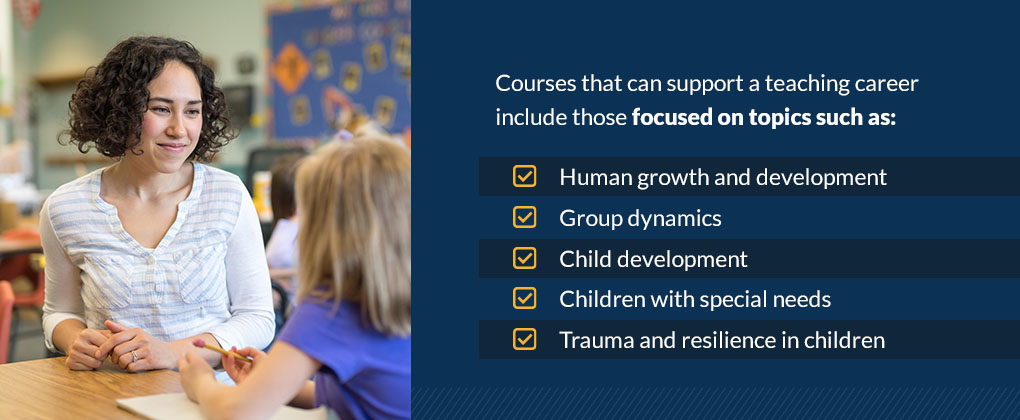
Future teachers can benefit from taking psychology courses to learn about human behavior and development. Courses that can support a teaching career include those focused on topics such as:
Enrolling in philosophy courses can expand your mind and help you develop critical thinking skills. Philosophy encourages students to question assumptions, analyze arguments and promote ethical reasoning. Philosophy helps students learn how to think and can help teachers understand their students.
While you’re studying to become a teacher, consider tutoring other students. Tutoring is an effective way to build practical teaching skills
Once you have earned your degree or degrees, becoming a certified teacher will require a couple of additional steps.
Some of the things you’ll have to do to become a teacher will depend on where you live. For those residing in MA, you’ll have to pass the Massachusetts Tests for Educator Licensure (MTEL), which evaluates content knowledge in the subject you plan to teach. There are multiple available license types for teachers in different positions and points in their careers:
There will be specific requirements for different roles. Here are some examples of requirements you will likely need to meet:
Now that you have an idea of what to study to become a teacher, you can start planning your path to the classroom. Whether you’re straight out of high school or restarting your education after gaining some life experience, we’re open to students from all walks of life. Mount Wachusett Community College was founded in 1963 and offers quality education and assistance from our Career Services Center, which offers a wide range of tools and resources to assist students in their job search.
MWCC is proud to be affordable, convenient and student-focused. Once you’ve completed your associate degree with MWCC, you can use our transfer services to help you transition and earn your bachelor’s degree. We look forward to hearing from you and hope you will request more information if you have any questions.
If you’re a transfer student or ready to take the first step in your teaching journey, fill out an application today!

Your journey starts with a single step. We have all the information you need to move forward with confidence. Reach out today to learn more about life at The Mount and how to get started.
