Robotics Technician Certification FAQs
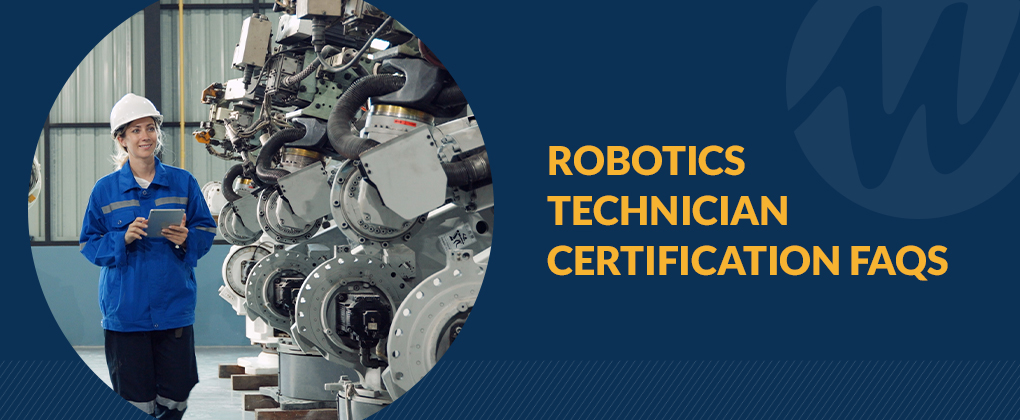


If you’re uncertain about what a robotics technician certificate can offer you, it’s important to understand what the career you’re considering going to school for actually involves. After all, getting certified as a robotics technician can lead you to a number of manufacturing career opportunities across a range of sectors. It provides you with the skills needed to solve key problems in the installation, repair and maintenance of innovative applications.
But before you begin your journey in obtaining a robotics technician certification, questions will inevitably pop up in your head. When you’re weighing up your options, this can cloud your judgment and make an exciting part of your life feel a little too daunting.
To make sure you’re on the right path for your career goals, below are the most frequently asked questions (FAQs) about studying for a certification as a robotics technician.
A robotics technician certificate is a training program that educates students on specialized knowledge. It involves participating in a program that combines theory and practice to help students develop skills in robotics repair, schematics and general principles.
The certificate study itself will focus on key fundamentals, such as robot programming, automated system repair, electronics and programming logic controller (PLC) operation. The learning includes practical guidance and a focus on automated systems, which gives students a deeper understanding of how to apply the knowledge in a modern manufacturing workplace.
The majority of people who start a career as a robotics technician have studied for a certificate in robotics, but many have additional education in science, technology, engineering and math (STEM) fields. Whether you are just graduating from high school or have already started your career, an associate degree in engineering is a great first step in becoming a robotics technician.
However, you may not need a degree to become a robotics technician. Depending on your career path, you may be able to pursue certifications and career training to enhance your knowledge in robotics. Mount Wachusett Community College offers multiple training programs:
A robotics technician certificate provides a balance of both hard and soft skills, while also giving you the capabilities needed to succeed in a future-focused industry. You’ll develop team-building skills, safety knowledge and improve your communication. This can give you the confidence and qualifications needed to do the following effectively:
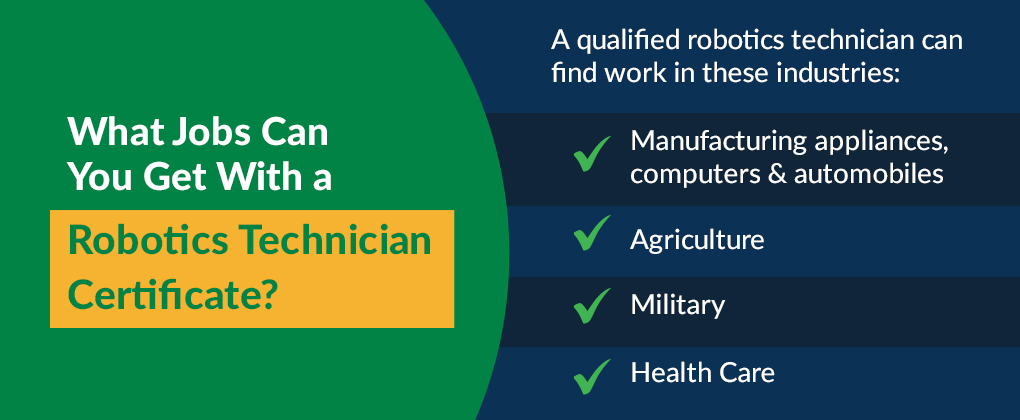
Knowing what jobs and industries you can work in as a robotics technician is an important part of finding the right career path after completing your course. A qualified robotics technician can find work in manufacturing industries where appliances, computers and automobiles are produced. However, many robotics technicians can also find career paths in agriculture, the military or health care.
The range of career choices for qualified technicians is anticipated to continue to expand as technology advances and the need for efficient robotics increases.
While this may vary depending on the industry the individual works in, years of service and role specifics, the current average salary for a robotics technician in Massachusetts is roughly $91,309.
In terms of average pay, robotics technician jobs in MA are quite competitive. For example, in a broader view of robotics and technology-associated salaries across the country, the Bureau of Labor Statistics (BLS) reports the median annual wage for electro-mechanical technician-related roles as $70,760.
Any career that interests you and makes you want to pursue a certification is worth your time and effort. But salary and career opportunities aside, it’s important to feel like you’re on the right path for your specific goals. Some of the things to consider when deciding if a robotics technician job is worth pursuing for you include:
Robotics is an excellent career for the future. Industrial robotics is growing rapidly, and this growth will invariably create gaps in the ability to find skilled individuals who are familiar with it. This presents a unique opportunity for those who are actively looking to gain qualifications in robotic technologies.
Technological innovations and the implementation of artificial intelligence (AI) across multiple industries mean an increased need for humans to work alongside them. Future workplaces are expected to be a streamlined hybrid of robotics and skilled people to program, monitor and fix them as needed.
Mount Wachusett Community College (MWCC) offers a supportive environment for you to learn, develop and achieve your goals. We care deeply about our students’ success and prepare them for the future with detailed but clear learning support.
Our automation technician courses and certificates introduce you to the knowledge needed for success, guiding you through key learning that involves hands-on situations, troubleshooting and safe operating procedures.
Are you considering a career as a robotics technician in Massachusetts, but don’t know where to start? Contact our admissions team today and find out how we can help you get there!

Your journey starts with a single step. We have all the information you need to move forward with confidence. Reach out today to learn more about life at The Mount and how to get started.
