Are you fascinated with the study of life in all its forms? Or are you inquisitive about the interconnectedness of living things and humans with the environment? If so, you should pursue a career in biology. Besides the fulfillment you’ll get from following your passion, you can do many things with a biology degree. While you don’t need to know everything at this phase, you should know what to study to become a biologist.
There are several aspects and subfields of biology, including microbiology, zoology, botany and environmental science. This guide outlines vital information you should know to pursue your dream, including what you need to study to become a biologist and more.
What Degree Do You Need To Become A Biologist?
Typically, you require a bachelor’s degree to be a biologist. However, you can start with an associate degree at a community college to gain foundational knowledge and get the required education to transfer to a four-year program.
Associate Degree
An associate degree in biology is the stepping stone you need to kick-start your career as a biologist. This degree takes as little as two years to complete, and gives you all the basic knowledge you need to excel when moving to a four-year university or college. Some plus sides to pursuing an associate degree in a community college include:
- Reduced cost: Earning your associate degree in biology can save you a lot of money and reduce the overall cost of a bachelor’s degree.
- Early workforce entry: An associate degree grants you early entry into the workforce. With it, you can apply to entry-level positions like laboratory assistants, technicians and pharmaceutical sales representatives. It gives you an edge in starting to earn money sooner, allowing you to save toward your four-year university degree.
- Transferable credits: At the end of an associate degree program, you can transfer your credits to a 4-year university program. This option is cost-effective because it allows you to obtain relevant credits at a lower cost and continue your education afterward.
- Flexibility: Community colleges offering associate degrees operate on flexible schedules to accommodate a diverse range of students, including commuters and nontraditional students. This advantage makes balancing work and other areas of your life with school easier.
Bachelor’s And Graduate Studies
To pursue a career as a biologist, you will likely need to complete a bachelor’s degree in a biological science at a four-year college. A more common and affordable route to achieving a bachelor’s degree is to start with an associate degree and transfer credits into a four-year program. Mount Wachusett Community College has transfer agreements with public and private four-year universities, ensuring a seamless transfer of credit for your biology studies.
You can also explore graduate studies, such as a master’s degree or a doctorate, in a specialized area within the field — for example, biochemistry, botany or biomedical engineering.
What Types Of Biology Are There?
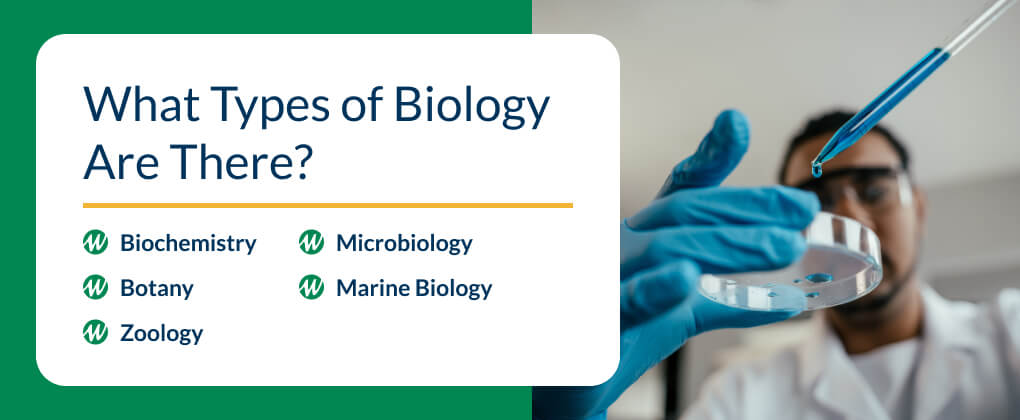
Because biologists study varying life forms, there are several different fields within biology. Let’s examine some primary fields you can explore within biology:
- Biochemistry: This field of biology deals with the chemical and physicochemical processes occurring within and related to living organisms. Think of it as studying the chemistry of life.
- Botany: This field involves the scientific study of plant life, including its ecology, genetics, classification and evolution.
- Zoology: This field deals with the scientific study of animal life, including the structure, classification and physiology of animals.
- Microbiology: This field of biology studies microorganisms, such as viruses, fungi and bacteria.
- Marine biology: This field involves the scientific study of the diverse life forms in the oceans and other aquatic environments.
Other Helpful Courses For Biologists
Biology is a broad course that can be supplemented with several foundational courses to better prepare you for success. Some other helpful and supplemental courses you can explore include:
- Mathematics: As you’ll soon learn, biologists perform tasks like data collection and analysis. A solid background in mathematics helps to ensure smooth sailing in this regard.
- Statistics: A course in statistics prepares you for essential tasks such as data interpretation in your line of work as a biologist.
- Computer science: This course equips you with the foundational knowledge of computational skills. It also teaches you the tools you’ll need for analyzing vast datasets and accurate reporting.
- Chemistry: Having a foundational knowledge of chemistry is essential for understanding concepts such as the interactions between living organisms.
How To Prepare For Becoming A Biologist
The journey to becoming a biologist can be exciting, and you want to be as prepared as possible. These tips will help you prepare for becoming a biologist:
- Explore different subfields: At this beginning phase, you can start exploring the different subfields of biology to know which ones pique your interest the most.
- Gain hands-on experience: Take advantage of opportunities to gain hands-on experience. Consider volunteering for projects that offer valuable exposure in relevant areas.
- Develop relevant skills: To thrive as a biologist, you need a combination of scientific knowledge, analytical skills and critical thinking skills. Take the opportunity to develop these skills early on in your journey.
- Research associate degree programs: The associate degree program you choose plays a big part in your future success — choose a program with quality education and extensive student support networks to ensure your success.
What Do Biologists Do?
The work of biologists is diverse and broad. Biologists study all life forms, including plants, animals and microorganisms, and how they interact with their environments. While specializations will vary widely, in general, the work of a biologist encompasses:
- Research and experimentation: Biologists conduct in-depth research and experiments into different areas of biology, such as genetics, cell biology and evolution. They conduct research and experiments in laboratories or the field to understand how living things function.
- Data collection and analysis: Biologists use the data from research and experiments to search for patterns and develop theories and meaningful conclusions about biological processes.
- Writing and publishing: Biologists record detailed reports about their research findings, which are crucial to solving problems related to human health and medicine, environmental conservation, food and agriculture and more.
What Jobs Can You Get As A Biologist?
Where you’ll spend time as a biologist will depend on your chosen field and area of expertise. The range of places you can work as a biologist includes:
- Laboratories: As a biologist, you’ll spend most of your time conducting laboratory experiments and research.
- Fieldwork: When you’re not spending time in the lab, you may carry out research outdoors, especially if you specialize in fields like environmental biology or botany.
- Industry-specific environments: These can range from pharmaceutical companies and clinical laboratories to botanical gardens and zoos.
- Academic institutions: If you choose to pursue a career in academia, you can teach biology classes, mentor furture biologists and conduct research for the university.
Kick-Start Your Career At MWCC

Biologists play a crucial role in enhancing life on Earth, and their valuable contributions significantly impact various aspects of human well-being. You’re making a bold choice to pursue a career in biology. Now that you know what you have to study to become a biologist, you need all the resources and support you can get to succeed.
For over 62 years, Mount Wachusett Community College has helped aspiring biologists like yourself by providing them with everything they need to kick-start their careers. Our MWCC associate degree in biology is affordable and opens the doors to pursue several valuable outcomes, including a four-year degree or early workforce entry. Schedule a visit with us to learn more.


